


Working from home
Table of contents
Table of contents
Working from Home in an Apartment: Ergonomics and Productivity in Small Spaces
30.04.2026
For many students and trainees, working from home has long become part of everyday life—this also applies to Staytoo apartments. Whether it’s online lectures, study phases, or remote jobs, having a home office in your apartment has become standard and is no longer something unusual.
However, working from home can be challenging—especially in small apartments with limited space. In compact living environments, the difficulties of working from home quickly become apparent: limited space, no separate office room, and often the challenge of creating a functional workspace.
Yet this is exactly what is essential in order to work in a focused and efficient way. This is where ergonomics and productivity play a crucial role.
When you are working from home for several hours a day, these issues add up and can have a big impact on your overall well-being.
A poorly set up workspace can lead to tension, faster fatigue, and concentration problems. At the same time, it becomes harder to work in a structured way and stay focused.
A well-thought-out home office, on the other hand, not only provides more comfort but also helps you work more efficiently, complete tasks faster, and clear your mind.
Even in student apartments, ergonomics and productivity can be implemented easily. It simply requires using the existing furniture in a smart and intentional way.
Setting up a home office in an apartment: How to achieve ergonomics and productivity in small spaces
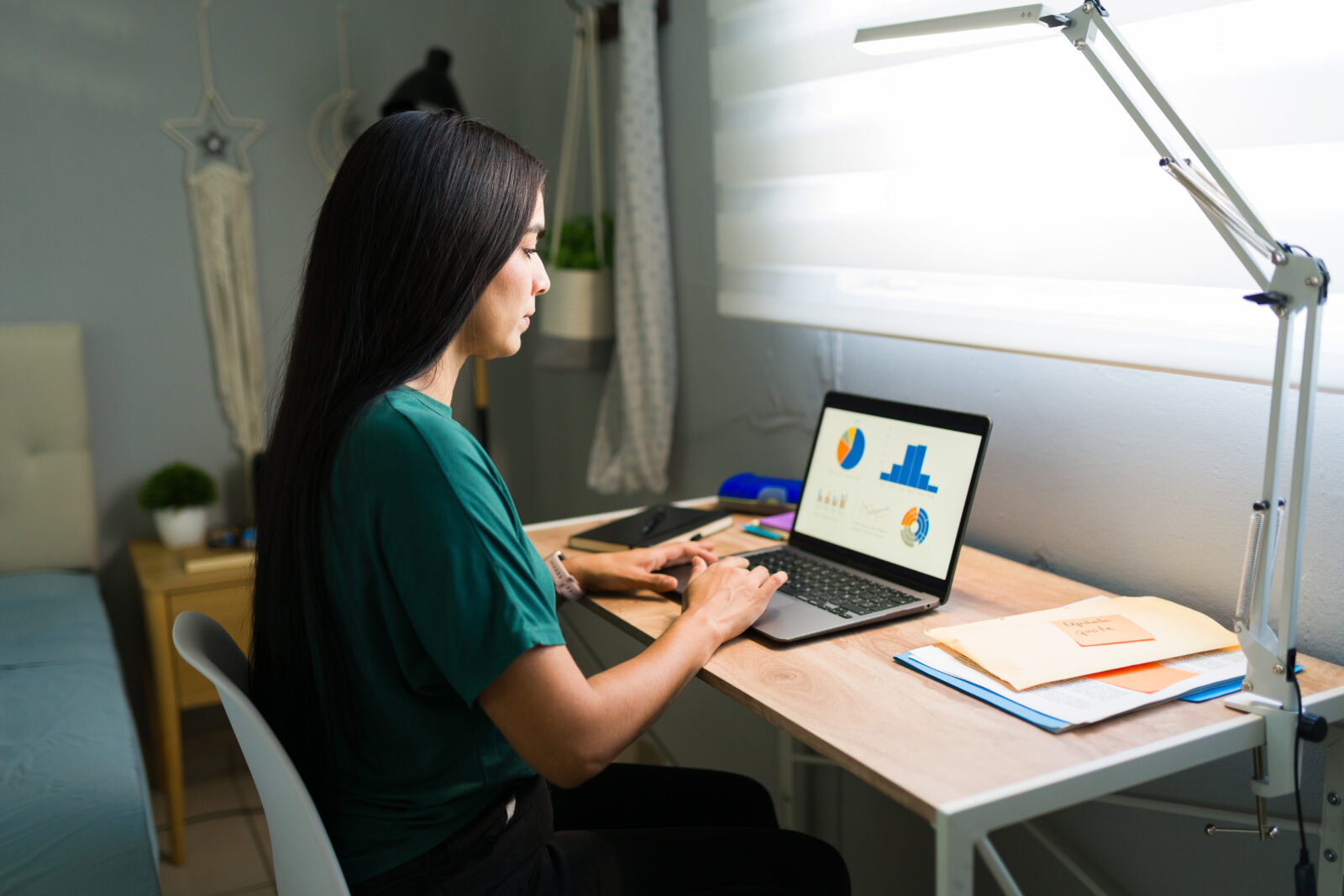
A well-designed home office does not start with more space but with making multifunctional use of the space available. Especially in furnished apartments, many essentials are already provided: a desk with drawers, wall shelves, and a clear room structure.
Under these conditions, the workspace can be set up not only in a stylish way, but also in a compact and smart manner. Now it’s all about making the most of the available space and creating an inspiring work environment.
This results in a small home office that is not only space-saving, but also functional, comfortable, and productive.
Smart structuring of the workspace
The most important rule is to clearly define your workspace when space is limited. Having a fixed corner in the apartment helps bring structure into your daily routine and creates a clear separation between work and leisure.
Even small, space-saving adjustments can make a big difference:
- Use the desk exclusively as a workspace
- Place personal items intentionally instead of leaving them scattered
A clearly structured workspace helps you get into work mode faster and stay more focused.
Implementing ergonomics with simple means
An ergonomic workspace for working from home is not about expensive furniture—it’s about mindful use. A height-adjustable desk is not necessarily required to work comfortably, both physically and mentally.
A well-designed workspace promotes productivity and can also be achieved with a simple chair instead of an office chair.
Key fundamentals include the following:
- A screen at eye level
- An upright yet relaxed sitting posture at the desk
Especially in a home office, the impact of posture on concentration is often underestimated. Even small changes—such as raising your laptop or simply improving your sitting position—can lead to a more comfortable workspace in the long run.
Even if your desk is not height-adjustable, you can easily bring your screen to eye level. Study books are perfect for this. This quickly turns your desk into a central workspace, while shelves provide additional storage for other books. It’s important that the work surface be clearly separated from the rest of the room, kept uncluttered, and that everything essential be within easy reach.
This creates a corner in your living space that integrates harmoniously into the apartment.
Organization and clarity for greater productivity
A tidy workspace not only provides better overview but also creates mental clarity, which is essential when you are working from home in a small apartment. Therefore, everything that is not needed should be kept out of sight.
Practical solutions include the following:
- Small storage boxes
- Structured filing areas
- Fixed places for important documents
Using natural light and atmosphere consciously
In addition to furniture and structure, the environment also plays an important role. Natural light has a positive effect on both concentration and well-being. If possible, curtains should remain open while studying or working.
A floor lamp in the apartment can also provide additional lighting and create a pleasant working atmosphere. A good light source has a direct impact on mental state and concentration.
Creating routines to structure everyday life
A well-designed workspace provides a solid foundation for working from home—but true productivity comes from habits. Fixed working hours help structure the day and set clear boundaries. Regular breaks are also essential to maintain focus over time.
A clear daily structure contributes significantly to feeling more balanced and satisfied—how exactly this works is explained in this article: “10 tips for more satisfaction in everyday life.”
If you’d like to take a closer look at the mental health side of working from home, the World Health Organization shares additional tips on staying mentally healthy at home.
Working productively in small spaces
Working from home in an apartment does not mean sacrificing comfort or efficiency. On the contrary, those who use their available space consciously can create a functional and pleasant workspace even in a few square meters.
With simple adjustments, a clear structure, and a focus on ergonomics, productivity can be significantly increased—without much effort.
Especially for students and trainees, this creates a work environment that can be flexibly integrated into daily life and provides long-term support. Anyone who has not yet made optimal use of their space can start implementing these approaches right away and noticeably improve their working area.