


Why Social Media Makes Us Unhappy
Table of contents
Table of contents
Why Social Media Makes Us Unhappy: The Illusion of Perfection
25.08.2026
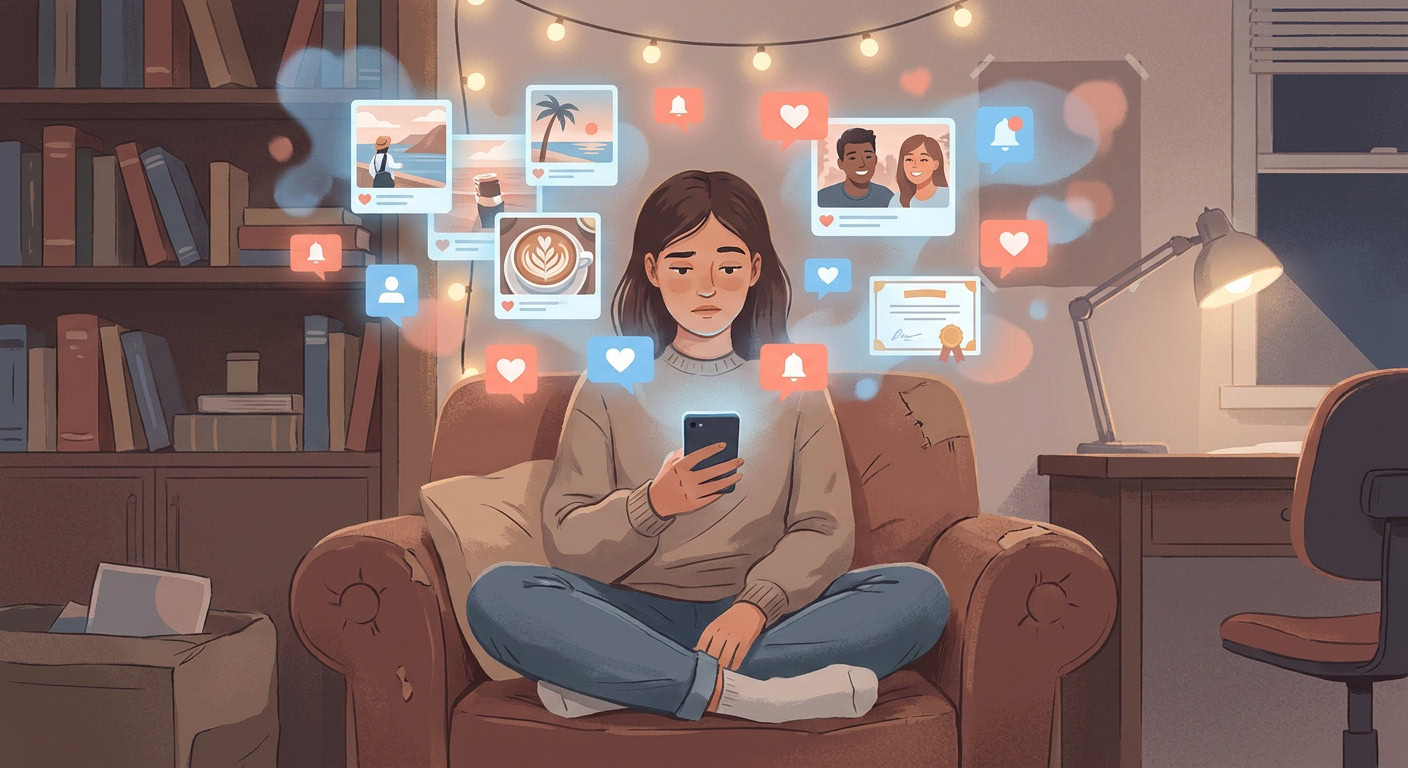
Instead of looking out the window first thing in the morning, our eyes often go straight to our smartphones. What starts as a quick glance at Instagram or TikTok can easily turn into ten minutes of scrolling. Before long, the first photos and videos appear in our feed: the dream vacation by the sea, the perfectly prepared breakfast, the new outfit, or the next career milestone. Suddenly, it seems as though everyone has their life under control—except us.
Does this routine sound familiar? It probably does.
Social media has long become part of our everyday lives. Today, social networks connect people all over the world, enable communication, provide inspiration, and offer countless opportunities to stay connected. At the same time, however, many people feel increasing pressure to keep up. The seemingly perfect world on social media platforms can cause us to view our own lives more critically and become increasingly dissatisfied.
But why does everything on social media seem so perfect? Why do we constantly compare ourselves to others? And where does true happiness actually come from? These are exactly the questions we explore in this article.
Why does everything on social media seem so perfect?
Who doesn’t know the feeling? You scroll through social media and mostly see only the highlights of other people’s lives. Hardly anyone shares their stressful Monday morning, failing an exam, or arguing with friends. Instead, our screens are filled with perfect vacations, achievements, and special moments.
The perfect world in your feed: How curated content changes our perception
What we see every day is rarely the complete reality of someone else’s life. Instead, it is a carefully curated selection, often enhanced with filters. Images are edited, unflattering scenes are cut out, and posts are revised multiple times before they are published. Influencers and content creators invest enormous amounts of time into making their content look as perfect and professional as possible.
As a result, social media creates a seemingly perfect reality that has very little in common with real life. Yet this is what we compare ourselves to. Our brains forget that we are only seeing the highlights. Instead, we compare our entire lives with the best moments of other people.
Why do we constantly compare ourselves to others on social media?
We compare ourselves to others throughout our entire lives. Comparison is part of human psychology. Long before smartphones existed, we looked to the people around us for orientation.
Today, however, these comparisons happen constantly—not just with relatives, friends, or neighbors, but with millions of people around the world.
The psychology behind it: Why we long for seemingly perfect lives
From a psychological perspective, we often compare ourselves to people who appear more successful, more attractive, or happier than we are. In doing so, we usually overlook the fact that we rarely compare ourselves to people who are worse off.
This desire for a similar life can be motivating, but it often leads to frustration, jealousy, or even envy toward people we do not actually know.
It becomes especially problematic when passive social media consumption dominates. People who only scroll, watch posts, and constantly compare themselves to others tend to develop more negative emotions than those who actively create content or interact with others.
Social media use can become particularly harmful when it consists mainly of constant comparisons. As a result, not only does our self-esteem suffer, but our overall life satisfaction can also decline over time.
How do algorithms on TikTok and other platforms influence our behavior?
Whether it’s TikTok, Instagram, or Reddit, every platform pursues a similar goal: keeping users on the app for as long as possible.
Why algorithms keep us on digital platforms for longer
By now, everyone knows that algorithms constantly analyze which content we watch, like, comment on, or view repeatedly. Based on this information, our feeds are continuously personalized so that we see exactly the content most likely to capture our attention.
The problem is that the longer we scroll, the more information our brains have to process. At the same time, new content keeps appearing, meaning there is never a natural stopping point.
As a result, we can spend several hours online every day without even noticing it.
Can social media really make us unhappy—or even depressed?
The answer is: it depends.
Social media alone does not automatically make anyone depressed. No psychologist would claim that social media is inherently harmful. What matters is how we use social networks every day and what kind of content we consume.
The fact remains, however, that intensive social media use, constant comparison, and the feeling of never being good enough can negatively affect our well-being. What begins as temporary dissatisfaction can gradually develop into a downward spiral that increasingly shapes our thoughts.
It becomes especially problematic when our self-esteem depends almost entirely on likes, followers, or other people’s reactions. Once this kind of validation becomes the center of everyday life, it can become toxic in the long run.
In addition, some people begin to base their entire identity on how they are perceived by others. This fixation on external validation can eventually have negative effects on mental health.
That does not mean that every period of intensive social media use automatically causes a mental health disorder. However, it is worth regularly reflecting on how much time you spend online and paying attention to how you feel after scrolling.
If you want to learn more about mental well-being and when it may be time to seek support, you can find additional information on the website of the Federal Institute of Public Health (BIÖG).
What does the illusion of perfection distract us from?
The more we consume other people’s lives, the less attention we pay to our own. Perhaps this is the real problem.
While looking at someone else’s vacation photos, we sometimes overlook the beautiful moments in our own lives. While others seem to be constantly traveling, we forget that spending an evening with friends or taking a walk with family can be just as valuable.
The illusion of perfection shifts our attention away from the real world. It fuels the constant process of comparison, even though every person has different circumstances, goals, and challenges.
It can also lead us to think more materialistically, believing that happiness depends on expensive trips, designer brands, or a perfect lifestyle.
At the same time, it distracts us from the things that truly make us happy: genuine friendships, meaningful conversations, shared experiences, time with family, or simply moments of peace.
Not everything has to be documented or shared online. Some memories become especially meaningful precisely because they stay in our minds instead of appearing on social media.
10 tips for a healthier relationship with social media
Completely giving up social media is neither necessary nor realistic for most people. A more mindful approach is far more beneficial.
- Limit your daily screen time and regularly check how much time you spend on social media.
- Unfollow accounts that consistently make you feel bad about yourself.
- Practice a regular digital detox to reconnect with the present moment. If you’d like to know what just a few days without social media can feel like, read our article “Digital detox for students: 3 day without social media – my personal experiment.”
- Think critically about the content you consume and remember that much of it is edited, filtered, and optimized.
- Spend more time with people in the real world instead of exclusively online.
- Use social media for inspiration rather than constant comparison.
- Find your own healthy balance between digital connection and offline time.
- Experience special moments with all your senses instead of through your phone’s camera. Whether you’re at a concert, watching a sunset, or spending time with friends, it’s worth leaving your smartphone in your pocket. The best memories are created in your mind—not on your screen.
- Regularly ask yourself what truly makes you happy. Reflect on the question: What makes me happy? Take time to think about your own wishes, goals, and values. Real happiness is often found in the small things we easily overlook in everyday life.
- Give yourself intentional breaks and become more aware of your surroundings. In everyday life, we often rush from one appointment to the next and reach for our phones during every free minute. Take a break. Breathe deeply. Look up at the sky. Observe nature, or simply enjoy the present moment. These pauses help bring your attention back to the here and now.
By following these tips, you can significantly reduce the negative effects of social media without giving it up completely. Even small changes can help you build a healthier relationship with social media.
For more advice on healthy digital habits and safer social media use, you can also visit Internet Matters.
Conclusion: Real happiness doesn’t begin in your feed
Social media can inspire, connect, and entertain. However, it usually shows only a small part of reality. Anyone who constantly compares themselves to this seemingly perfect world runs the risk of missing out on their own life.
Real happiness rarely comes from perfect pictures or having as many followers as possible. It grows through genuine encounters, honest conversations, and the small moments of everyday life—usually when the smartphone stays in your pocket.
If you notice that constant comparison is becoming increasingly difficult for you, it is worth paying more attention to your own mental health. You can learn how to strengthen your well-being in our article “Promoting mental health.”. You’ll also find more inspiration for greater peace of mind and happiness in everyday life in our article “10 tips for more satisfaction in everyday life.”.