


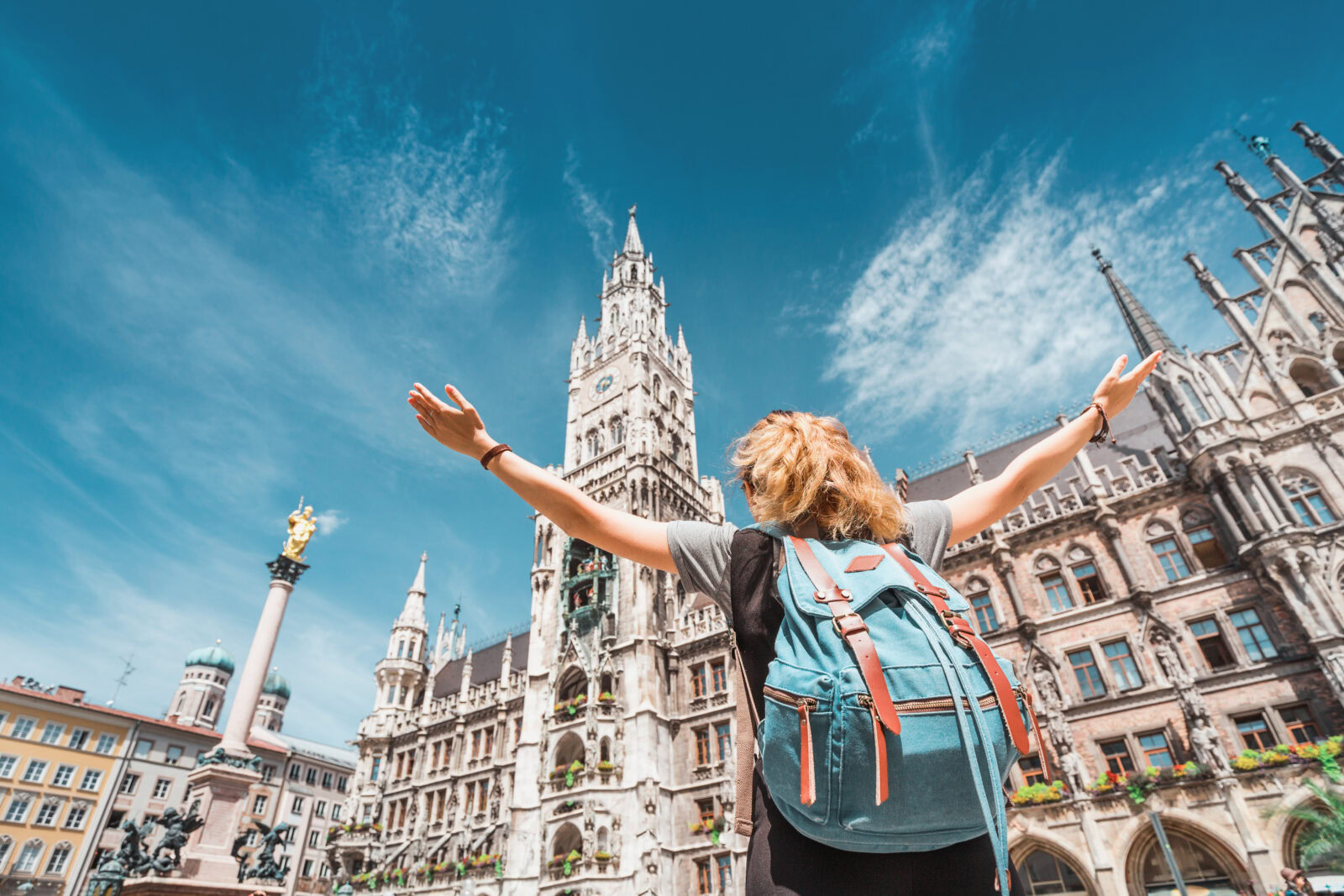
Studying in Munich
Table of contents
Table of contents
Studying in Munich: Why the Isar Metropolis is the Perfect Choice
26.10.2026
This is the sixth article in our new city series! In the first parts, we showed you what makes studying in Berlin, Bonn, Kaiserslautern, Leipzig, and Nuremberg so special. Today, we’ll take you to Munich.
Munich is one of the cities many people want to move to for studying, working, or an internship—and at the same time, it’s one of the places where housing is particularly scarce.
Anyone looking for a student dorm, co-living space, or a small apartment in Munich quickly faces many questions: Where can I find something affordable? How can I balance my studies, job, and free time? And in which district will I truly feel at home?
In this article, we’ll explore what makes Munich so attractive for students and young professionals, why living concepts like co-living are becoming increasingly important, and what role a new building at Ottobrunner Str. 17, 81737 München can play in the future.
A City with High Quality of Life—and High Expectations
Compared to many other German cities, studying in Munich has some unique features:
- Quality of Life: Many parks, the Isar River, the English Garden, excellent public transport, and a safe cityscape—these are points that are always mentioned when talking about Munich.
- A Mix of Tradition and Modernity: Beer gardens, traditional attire (Tracht), and Oktoberfest are just as much a part of the city as tech start-ups, international companies, and modern universities.
- Scarce Housing: Students, in particular, know the problem: finding a room or apartment can take a long time, and rents are often high.
Finding a student dorm or a small apartment here not only secures a place to live but also a piece of quality of life in this mix of a big city with a “village feel.” A good housing situation is the foundation for a successful experience of studying in Munich.
Studying in Munich—Many Opportunities in a Compact Space
Munich is both a university hub and a business location. This has a direct impact on the daily lives of students:
- Universities and Colleges: With institutions like LMU, TUM, and the Hochschule München, there is a wide range of degree programs, many of which are internationally oriented.
- Strong Economy: Whether it’s the automotive industry, IT, media, biotech, or agencies—companies in and around Munich offer internships and working student positions, and often entry-level jobs after graduation.
- International Environment: Exchange programs and international companies attract people from many countries. This creates a diverse urban society from which students, in particular, benefit.
Living in Munich means short distances: from the student dorm or co-living apartment to the university, from campus to a part-time job, and from an internship to the Isar River.
Munich’s Top Universities: An Overview for Your Studies
Munich is not just any university city; it is home to some of Germany’s most prestigious universities. The range of courses is vast and internationally focused.
Ludwig-Maximilians-Universität (LMU)
The LMU is one of the largest and oldest universities in the country. It offers an extremely broad spectrum of subjects, from humanities and social sciences to law, medicine, and natural sciences. If you are looking for a classic, research-intensive environment, the LMU is a top choice.
Technical University of Munich (TUM)
The TUM is one of the best technical universities in Europe and is designated as a University of Excellence. Its focus is clearly on engineering, computer science, natural sciences, and medicine. If you are passionate about technology and want to conduct research on future-oriented topics, the TUM is the perfect choice.
Munich University of Applied Sciences (HM)
The Hochschule München (HM) is the largest university of applied sciences in Bavaria and is ideal for anyone who wants to study with a practical focus in Munich. With degree programs in fields like technology, business, design, and social sciences, it offers an excellent link between theory and professional practice.
In addition, there are other specialized institutions such as the Academy of Fine Arts or the University of Music and Performing Arts, which complete Munich’s educational landscape.
Why Living Concepts Like Co-Living Are Gaining Importance
The traditional shared flat (WG) still exists, but it’s no longer the only option. In recent years, new forms of living have emerged that are specifically tailored to students and young professionals—for example, co-living in Munich and modern micro-apartments.
What Defines Co-Living?
Typical features include:
- Private Apartment or Studio: A small, self-contained area with a place to sleep, often with a private bathroom and sometimes a private kitchenette.
- Communal Areas: Spaces for cooking, studying, working, or socializing.
- Inclusive Services: Often, internet and utilities are already included in the rent, and sometimes services like laundry facilities, bicycle storage, or community events are added.
The advantage: Newcomers to the city can connect more quickly without having to sacrifice their privacy. For a city like Munich, where many people stay only for a specific period (e.g., for their studies, an internship, or a trainee program), this is a practical solution.
The Location: Ottobrunner Str. 17, 81737 München—What Makes It a Good Choice?
A new building at Ottobrunner Str. 17, 81737 München, fits perfectly into this picture. The address is in the southeast of the city (in the Ramersdorf-Perlach area) and combines several points that are interesting for students and young professionals:
- Connectivity: From here, you can reach the city center, universities, and major transport hubs in a reasonable amount of time using public transport. Depending on the line, both central stations and other parts of the city are easily accessible.
- Everyday Convenience: In the vicinity, you will typically find supermarkets, smaller shops, restaurants, and daily necessities. This makes it easy to organize daily life without long journeys.
- Position within the City: The southeast of Munich is known for its mix of residential buildings, offices, and green spaces. This can be appealing for those who don’t want to live right in the hustle and bustle of the old town but still value good connections to the city.
For students interested in a student dorm or co-living in Munich, a location like Ottobrunner Str. 17, 81737 München can be a sensible alternative to very central but often even more expensive neighborhoods.
How Apartments and Co-Living Fit into Daily Life
Whether it’s a classic student dorm, co-living in Munich, or a fully equipped apartment—what matters is how well the living concept fits your personal plans.
For many, the important factors are
- Predictable Costs: All-in rents that include utilities and Wi-Fi make budgeting easier, especially for those living alone for the first time.
- Furnishings: Those moving to Munich from another city or country rarely want to organize a complete set of furniture. Furnished apartments can remove this barrier.
- Community vs. Privacy: Sometimes you want to meet people; other times you just want peace and quiet. Modern living concepts try to accommodate both needs—with private apartments plus communal areas.
In a city like Munich, which is characterized by a lot of movement and a lively exchange of students and trainees, such flexible concepts are likely to become even more important.
Conclusion: Why Studying in Munich and New Living Concepts are a Good Match
Munich is a special case: high quality of life, a large university landscape, a strong economy—and at the same time, high rents and limited housing.
That’s precisely why additional offerings like student dorms, co-living spaces, and compact apartments are a crucial component to enable students and young professionals to live in the city.
With the new building at Ottobrunner Str. 17, 81737 Munich, another location is being created that embraces this development: a place tailored to the needs of a mobile, international, and student target group—with a focus on practical living, good accessibility, and the opportunity to not just live in Munich, but to truly arrive.